Lost Receipt Tax Deduction: How to Still Claim It
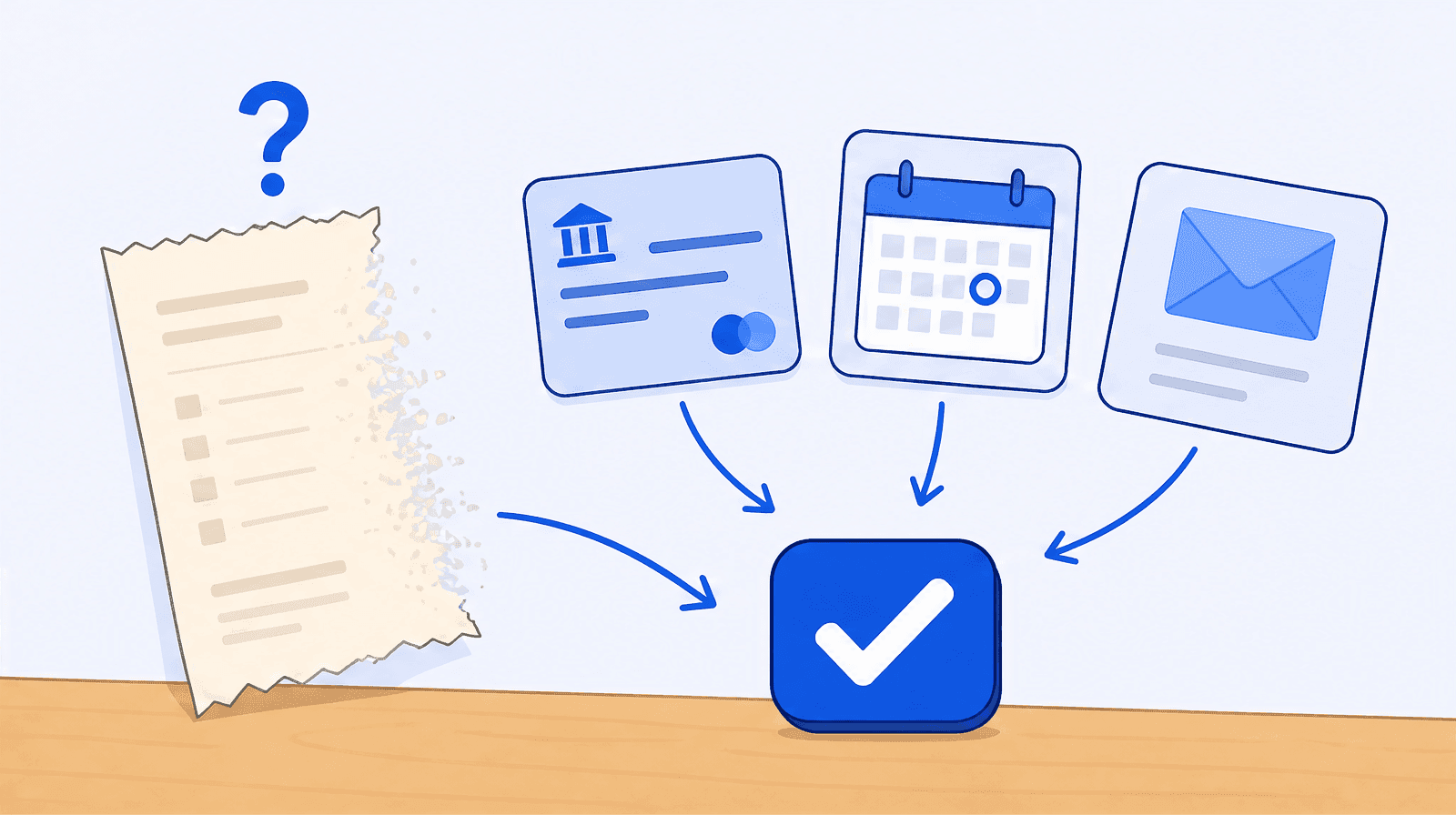
A lost receipt usually does not kill the deduction. Tax authorities care that you can prove the expense was real and business-related, not that you kept a specific slip. Bank and card statements, invoices, calendar entries, and a written note of the purpose can support a legitimate claim. The US $75 rule and the Cohan rule give further room.
You spent the money. It was for the business. You know that. But the receipt is gone, lost in a coat pocket, faded to a blank slip, or never handed to you. Now tax season is here and you are staring at a real expense, wondering if you have to eat the deduction.
Here is the relief: a lost receipt tax deduction is usually still claimable. Tax authorities care that you can prove the expense happened, not that you kept a particular slip of paper. Show the amount, the date, where you spent it, and why it was for your business, and you can often back up a legitimate write-off with other records. This guide covers what the IRS and the CRA accept instead, how the $75 rule and the Cohan rule actually work, and how to never lose a deduction to a missing receipt again.
This is general information, not personalized tax advice. The rules below are accurate at a high level, but your situation has details a guide cannot see. Confirm anything with real stakes with a qualified tax professional.
Short answer: a lost receipt tax deduction usually still stands
Often yes. The IRS and the CRA care that you can prove the amount, date, place, and business purpose of an expense, not that you hold the original paper. Bank or credit card statements, invoices, vendor duplicates, calendar entries, and contemporaneous logs can substantiate a legitimate business expense when the receipt is gone.
The catch is that "often" is not "always," and a few categories of spending have stricter rules. The rest of this article shows you exactly where the line sits.
What tax authorities actually require (it is not the paper)
The mental model worth fixing in your head: a receipt is evidence, not the deduction itself. The deduction exists because you incurred an ordinary and necessary business expense. The paper just helps you prove it. Lose the paper and you have lost one piece of evidence, not the underlying right to deduct.
The four things you must be able to prove
For most business expenses, you need to substantiate four facts:
- Amount. How much you spent.
- Date. When you spent it.
- Place. The vendor or location.
- Business purpose. Why this was for your work, not personal use.
If a single document or a small stack of documents lets you nail all four, you have a defensible claim. A credit card statement line that reads "Staples, $84.19, March 3," plus a quick note that it was printer paper and ink for client proposals, can carry an office-supplies deduction on its own.
US: the IRS burden of proof and documentary evidence
In the US, the burden of proof is on you, the taxpayer, to substantiate your deductions. The IRS states plainly that you must keep records such as receipts, canceled checks, and bills to support income and expense items, and that certain categories (travel, entertainment, gifts, and vehicle expenses) require additional documentary evidence (IRS, Burden of proof).
The good news is the IRS itself lists acceptable supporting documents beyond the cash-register receipt: canceled checks, account statements, credit card receipts and statements, and invoices all count (IRS, What kind of records should I keep). The same guidance points to a general three-year window for keeping records tied to a return, though some situations call for longer. When a receipt vanishes, the IRS has already told you what stands in for it.
Canada: what the CRA expects from self-employed filers
Most search results on this topic are US-only, which leaves Canadian freelancers and sole proprietors guessing. Here is the Canadian side.
The CRA requires you to keep your business records and supporting documents for at least six years from the end of the last tax year they relate to. It expects you to get receipts or vouchers when you buy something for the business, and for GST/HST registrants, those documents need to include the supplier's business number on purchases of $100 or more (CRA, Business records). Self-employed Canadians report these expenses on form T2125, and the same logic applies: if the original receipt is gone, other records that establish the four facts can support the claim. Because the GST/HST input tax credit side is stricter than the income-deduction side, a Canadian missing a high-value receipt should talk to an accountant before filing.
What proof can you use instead of a receipt?
When the receipt is missing, you build an "evidence stack." No single substitute is as clean as the original, but two or three together usually close the gap. Here is how common alternatives map to the four facts:
| Alternative proof | Amount | Date | Place | Business purpose |
|---|---|---|---|---|
| Bank or credit card statement | Yes | Yes | Yes (vendor name) | Add a note |
| Vendor duplicate or reprinted invoice | Yes | Yes | Yes | Often yes |
| Canceled check | Yes | Yes | Partial | Add a note |
| Calendar entry | No | Yes | Yes | Yes |
| Email confirmation or order receipt | Yes | Yes | Yes | Often yes |
| Contemporaneous log or notes | Yes | Yes | Yes | Yes |
Bank and credit card statements
A statement is the workhorse substitute. It shows the amount, the date, and the vendor: three of the four facts on its own. What it does not show is why the expense was for the business, so pair each relevant line with a short note. Many freelancers can use a credit card statement as proof of expense for routine purchases like software, supplies, and subscriptions, as long as the business purpose is clear.
Vendor duplicates and reprinted invoices
Before you settle for a statement, ask the vendor for a copy. Many merchants can reprint a receipt or resend an invoice from their own records, especially for larger purchases, subscriptions, and anything bought online. A reprinted invoice is often as good as the original because it carries all four facts. This is the cleanest fix and the one most people skip.

Calendar entries, emails, and contemporaneous logs
For expenses tied to events (a client lunch, a conference, a project site visit), a calendar entry establishes date, place, and purpose at once. Emails and order confirmations are strong because they are timestamped and name the vendor and amount. A contemporaneous log, meaning notes you made at or near the time of the expense rather than reconstructed months later, carries real weight because it is harder to dispute. The phrase to remember is "contemporaneous": records made in the moment beat memory written down in April.
The $75 rule, explained correctly (and where it does NOT apply)
You have probably heard that you do not need a receipt for expenses under $75. That is half true, and the half people drop is the important one.
The actual rule, from IRS Publication 463, is that for certain travel, entertainment, gift, and vehicle expenses under $75, you may not need to keep the physical documentary evidence (IRS, Publication 463). It is not a license to deduct small amounts with no support. You still must record the four elements (amount, date, place, business purpose), typically in a log or account book. The $75 figure relaxes the paper requirement, not the recordkeeping requirement. Many pages overstate this as "no documentation needed under $75," which is wrong and can get you in trouble.
Why lodging, travel, meals, and gifts are the exceptions
Two clarifications matter. First, the $75 threshold lives in the travel-and-entertainment rules, so it does not blanket every business expense category. Second, lodging is always an exception: you need a receipt for lodging regardless of amount, even under $75. When in doubt on travel and meals, keep the receipt.
The Cohan rule: claiming a reasonable estimate when proof is thin
This is the part the "I lost everything" searcher is hoping for. The Cohan rule comes from a 1930 court case (involving the entertainer George M. Cohan), and it lets a taxpayer who clearly incurred a deductible expense, but cannot fully document it, claim a reasonable estimate rather than nothing at all.
It is real, but read the fine print before you lean on it.
Its real limits
- The estimate must be reasonable and supported by some basis. You cannot pull a number from thin air. You need credible evidence that the expense happened and a rational way to estimate it.
- The IRS tends to allow the lowest plausible amount. Courts apply Cohan, but the bias runs against the taxpayer who failed to keep records. Estimation is a fallback, not a plan.
- It is barred for the strict-substantiation categories. Under Internal Revenue Code section 274(d), travel, meals, entertainment, and business gifts require actual substantiation. Cohan does not save you there. These are exactly the categories where a real receipt or log is non-negotiable.
Treat Cohan as the safety net under the high wire, not the wire itself. If you are relying on it for a meaningful amount, that is a conversation to have with a tax professional, not a DIY move.
Faded, water-damaged, or thermal receipts that went blank
Thermal paper, the kind most stores use, fades to a blank slip within months, especially in a hot car or wallet. A receipt you technically kept can be as useless as one you lost.
The fix is to capture a clear digital image while the print is still readable, then keep that. The CRA confirms that scanned images of paper documents are acceptable records when they meet recognized imaging standards, so a clean digital copy can stand in for a paper original (CRA, Acceptable format and imaging). We covered the Canadian digital-records question in more depth in are digital receipts valid for CRA audits. The lesson is the same on both sides of the border: photograph the receipt the day you get it, because the paper will not wait for you.
Step by step: how to reconstruct a lost expense before you file
If you are sitting on a missing receipt right now, work through this in order:
- Ask the vendor for a duplicate first. A reprinted invoice or emailed copy beats every other option. Start here.
- Pull the matching bank or card statement line. This gives you amount, date, and vendor.
- Find a second corroborating record. A calendar entry, an email confirmation, or a delivery notice that ties the spend to your business.
- Write the business purpose down now. One line: what it was for and which client or project. Do it while you still remember.
- Estimate only as a last resort, and only where allowed. If nothing else exists, the Cohan rule may apply outside the section 274(d) categories. Keep your estimate conservative and document how you arrived at it.
- Flag the high-stakes ones for your accountant. Large amounts, travel, meals, and GST/HST input tax credits in Canada are worth a professional review.
A reconstructed expense with two solid documents and a clear purpose note is a strong claim. Do not skip a legitimate deduction because the original paper is gone.
How to never lose a receipt again (the 10-second habit)
Every fix above is more work than the one habit that prevents all of it: capture the receipt the moment it lands in your hand. Snap a photo before it goes in your pocket. That habit turns a fading thermal slip into a permanent record and saves you the reconstruction scramble next spring.
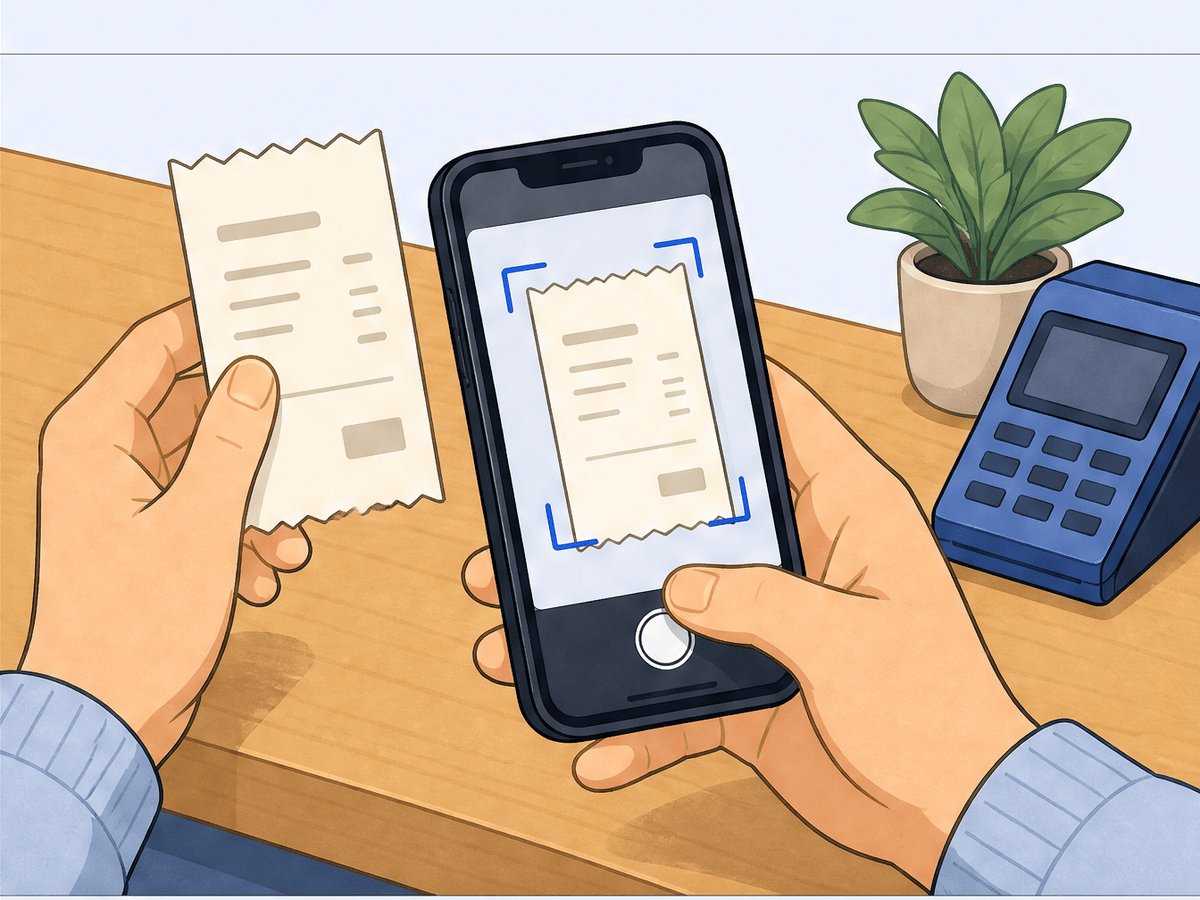
The trick is making capture so fast you actually do it. A photo dropped into a generic camera roll gets lost among screenshots and dog pictures. A receipt sent to a tool that reads it, dates it, and files it stays findable when you need it.
Frequently asked questions
Can I claim a tax deduction if I lost the receipt? Usually yes, if the expense was legitimate and you can prove the amount, date, place, and business purpose with other records like statements, invoices, or logs. A few categories (travel, meals, gifts) have stricter rules.
What proof can I use instead of a receipt? Bank and credit card statements, canceled checks, vendor duplicates and reprinted invoices, calendar entries, emails and order confirmations, and contemporaneous logs. Two or three together usually substantiate the expense.
Does the IRS accept bank or credit card statements instead of receipts? The IRS lists account statements and credit card receipts among acceptable supporting documents. A statement covers amount, date, and vendor, so add a note for the business purpose.
What is the Cohan rule and how does it work? It lets a taxpayer who clearly incurred a deductible expense claim a reasonable estimate when records are incomplete. It does not apply to travel, meals, entertainment, or gifts under section 274(d), and estimates tend to be allowed at the lowest plausible amount.
Do I need a receipt for expenses under $75? For certain travel and entertainment expenses under $75 you may not need the physical receipt, but you still must record the four elements. Lodging always requires a receipt regardless of amount.
How much can I claim without receipts? There is no fixed dollar limit. What matters is whether you can substantiate the expense with other credible evidence. The more you can document, the stronger the claim.
What happens if I get audited and have no receipts at all? You can still try to substantiate expenses with alternative documents and, where permitted, reasonable estimates under the Cohan rule. Categories under strict substantiation may be disallowed without proper records. This is a situation to handle with a tax professional.
Does the CRA accept missing or scanned receipts for self-employed expenses? The CRA accepts scanned images of paper documents that meet imaging standards, and self-employed filers report expenses on T2125. Keep records for at least six years, and note the stricter rules for GST/HST input tax credits.
How do I reconstruct expenses when receipts are lost? Ask the vendor for a copy, pull the matching statement line, find a second corroborating record, write down the business purpose now, and estimate only as a last resort where allowed.
Can I use a photo of a receipt instead of the paper original? Yes. A clear digital image is an accepted record in both the US and Canada, and it solves the fading-thermal-paper problem. Capture it while the print is still readable.
Stop losing deductions to lost receipts
The honest takeaway: most lost receipts are recoverable, but the cleanest deduction is the one you never had to reconstruct. The freelancers who keep the most write-offs are not the most disciplined filers. They just capture each receipt in the moment, before it can fade or disappear.
That is the whole idea behind scan-ai. Snap a photo or forward the email receipt, and the AI reads every line item including tax, dates it, and sorts it into US Schedule C or Canadian T2125 categories so it is there when you need it. You can even ask your receipts anything when a number does not add up. We keep it affordable on purpose, which we wrote about in why we keep scan-ai cheap.
Start free at scan-ai.ca: 20 receipt scans, no credit card. Capture the next receipt before it has a chance to go missing.
This article is general information, not tax advice. Tax rules change and depend on your specific situation. Confirm anything with real stakes with a qualified accountant or tax professional.