Canadian Self-Employed Deductions: The Complete Guide
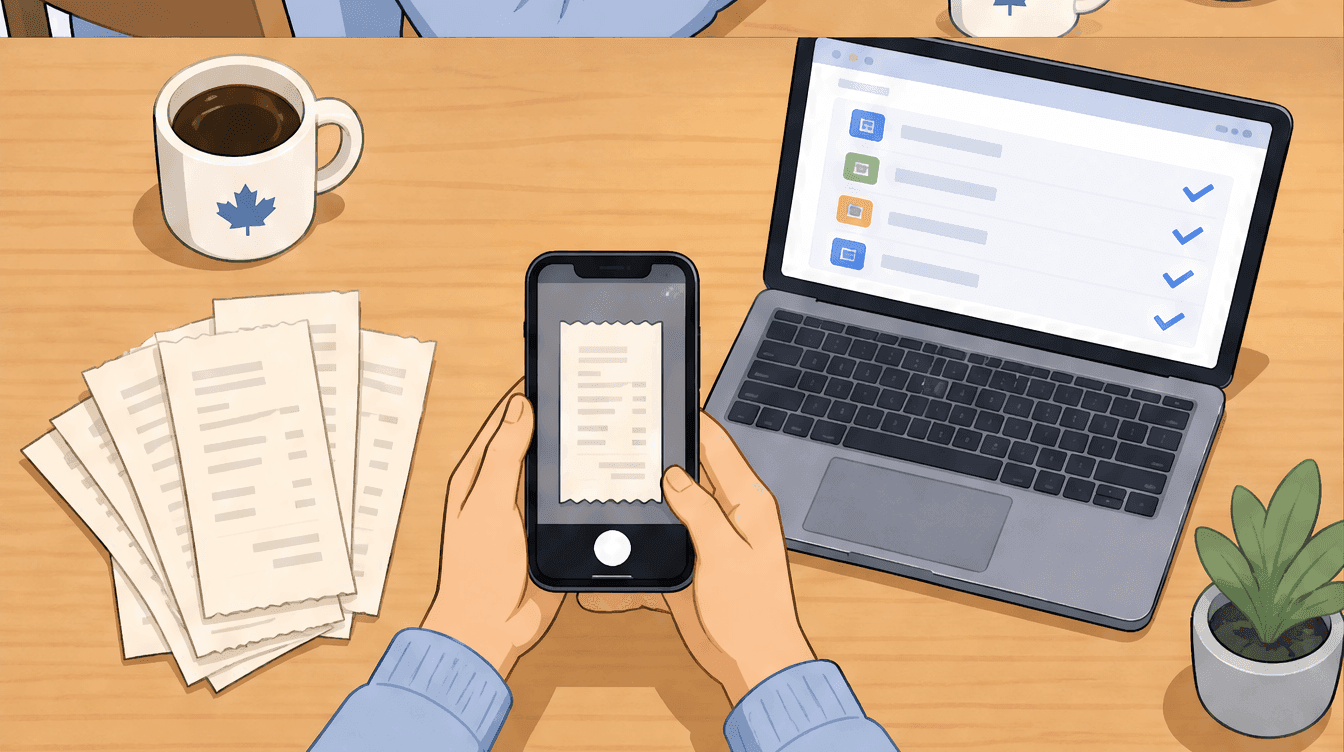
Self-employed Canadians can deduct the reasonable, business-use portion of costs like home office (line 9945), vehicle (line 9281), supplies, advertising, and professional fees on Form T2125. You claim only the business share and keep records for six years. The real work is capturing the ordinary expenses you already have, not finding exotic write-offs.
You earned the money. Now you are staring at a year of bank notifications, a folder of email receipts, and a shoebox of curling thermal paper, trying to remember whether that March coffee was a client meeting or just a coffee. Every dollar you spent to run your business is a dollar you should not pay tax on, but only if you can name it, sort it, and prove it. That is the real work of Canadian self-employed deductions: not finding clever write-offs, but capturing the ordinary ones you already have and putting each on the right line of the right form.
This guide is the plain-language version of the rules. It covers who files a T2125, what makes an expense deductible, and every business expense category mapped to its real T2125 line number, from advertising at line 8521 to business-use-of-home at line 9945. Then it walks through the three deductions people get wrong (home office, vehicle, meals), the ones they forget entirely, and the records the CRA expects you to keep. Figures are current for the 2026 tax year. This is general information, not personalized tax advice; where the stakes are high, confirm the details with an accountant or bookkeeper who knows your situation.
Who counts as self-employed in Canada (and why the T2125 matters)
If you earn business income that no employer withholds tax from, the CRA treats you as self-employed. That covers many people who do not think of themselves as "a business": freelance designers and writers, consultants, tradespeople, rideshare and delivery drivers, Etsy sellers, coaches, photographers, and anyone with a side hustle that brings in revenue. You do not need a registered company. Most self-employed Canadians operate as sole proprietors, reporting business income on their personal return.
The form that carries it all is the T2125, Statement of Business or Professional Activities. You file one T2125 per business, attached to your personal T1 return. The top reports your revenue; the expenses section is where every deduction goes, each on a numbered line. Get comfortable with those lines, because the rest of this guide is organized around them. When your bookkeeping already sorts spending into these categories, the T2125 stops being a year-end scramble and becomes a copy-and-paste job.
The golden rule: what makes an expense deductible
The CRA does not publish a fixed list of "allowed" purchases. Instead it applies a principle: you can deduct any reasonable expense you incurred to earn business income. Three words do the heavy lifting.
- Reasonable. The amount has to make sense for the business. A laptop for a freelance developer is reasonable; a boat, usually not.
- Incurred to earn income. There must be a business purpose. Personal spending is never deductible, and mixed-use costs (your phone, your car, your home) get split so you only claim the business share.
- Backed by a record. If you cannot show the CRA what you bought, from whom, when, and for how much, the deduction is exposed in an audit. A receipt or invoice is the proof.
That last point is where most claims fall apart: not at the rule, but at the recordkeeping. A bank statement shows that money left your account; it does not show what you bought or that it was for the business. The CRA's own guidance leans on supporting documents like receipts and invoices, which is why a tidy receipt system protects every line on your T2125. (See the CRA's T4002 guide, Chapter 3, for the full deductibility principle.)
Every Canadian self-employed deduction, mapped to its T2125 line
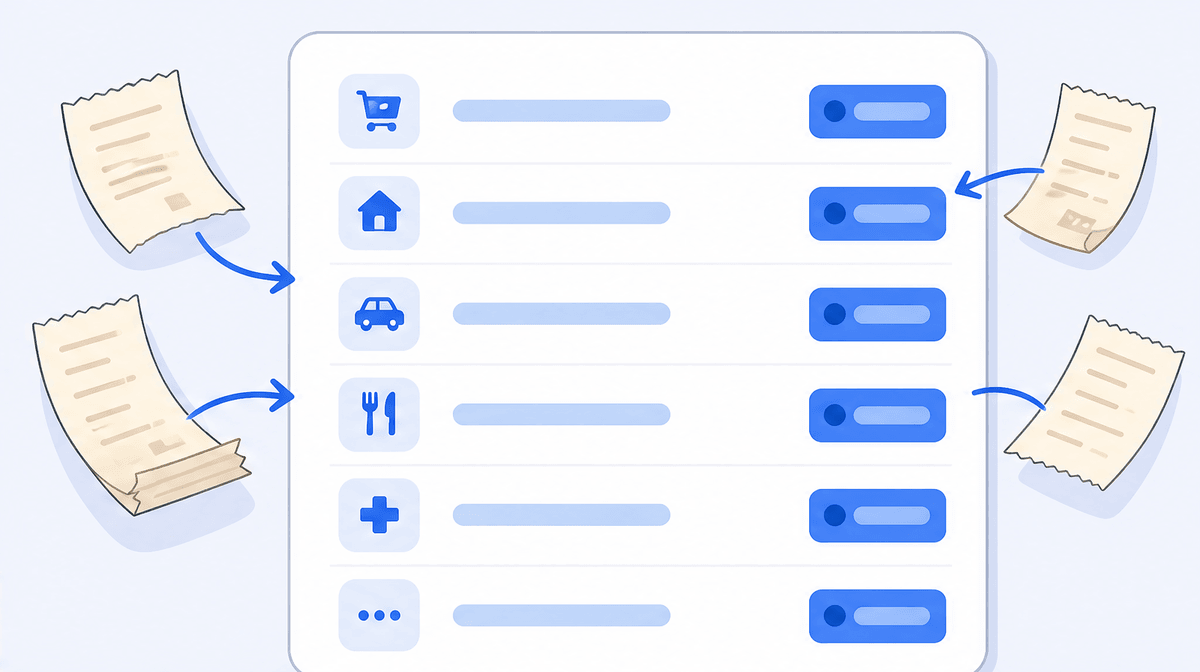
Here is the full set of business expense categories, each tied to the line where it lives on the T2125. Use this as your chart of accounts: if you can sort a purchase into one of these buckets as it happens, year-end is mostly done. Line labels follow the CRA's expenses-section page for the T2125; confirm any edge case against that page, because category wording is updated periodically.
Advertising and promotion (line 8521)
Online ads, print and radio, business cards, your website, sponsored posts, and the cost of promoting your services. Advertising in a non-Canadian medium aimed primarily at a Canadian market can be restricted, so foreign ad spend is worth confirming.
Meals and entertainment, the 50% rule (line 8523)
Client meals and entertainment with a clear business purpose, plus meals while travelling for work, generally go here at 50% of the cost. The half rule is the default for most self-employed Canadians, and it trips people up: you record the full receipt, but only half flows to your deduction. Narrow exceptions are covered later.
Bad debts (line 8590)
If you previously reported income you never got paid for and the amount is genuinely uncollectible, you can often write it off as a bad debt, but only if it was already counted in your income. Cash-basis income you never recorded cannot become a bad debt.
Insurance (line 8690)
Commercial liability, professional liability (errors and omissions), and insurance on business property or equipment. Insurance on the part of your home used for business is handled separately under business-use-of-home (line 9945), not here.
Interest and bank charges (line 8710)
Interest on money borrowed to run the business, business loan interest, and the fees on a business bank account or merchant processor. Interest on a personal loan only qualifies for the portion actually used for the business.
Business taxes, fees, licences, dues, and subscriptions (line 8760)
Annual business licences, regulatory fees, trade or professional association dues, and many software or industry subscriptions used for work. Club membership dues whose main purpose is dining, recreation, or sports are specifically not deductible.
Office expenses and supplies (lines 8810 and 8811)
Line 8810 (office expenses) is for consumable office items: pens, paper, stamps, small stationery. Line 8811 (supplies) covers materials you use up delivering your service or product. The catch many people miss: a desk, a filing cabinet, or a computer is a capital item, not an office expense. Those go through capital cost allowance (line 9936).
Legal, accounting, and other professional fees (line 8860)
Your accountant's fee, bookkeeping help, legal advice for the business, and the cost of preparing your tax and GST/HST returns. This is the line that pays for the professional whose job is to get the rest of the return right, which is why software does not replace them.
Rent, repairs, and maintenance (lines 8910 and 8960)
Line 8910 (rent) is for renting business property or equipment that is not your home. Line 8960 (repairs and maintenance) covers fixing business property and equipment. Repairs to your home office belong under business-use-of-home, apportioned to the business share.
Salaries, wages, and subcontractors (line 9060 and beyond)
If you pay employees, their wages and your share of payroll contributions are deductible. If you pay subcontractors or other businesses to do work for you, those costs are deductible too, often as subcontracts (line 9061) or cost of goods sold, depending on your business. Keep their invoices.
Travel (line 9200)
Airfare, trains, hotels, and transportation while travelling for the business. Meals on a business trip are the exception: those still go to line 8523 at the 50% rate, not into travel.
Telephone and utilities, including phone and internet (line 9220)
The business share of your phone, internet, and utilities. For a dedicated business line, that can be the full cost. For a personal phone and home internet you also use for work, you claim a reasonable business percentage, and you should be ready to justify it.
Motor vehicle expenses and the mileage logbook (line 9281)
Fuel, insurance, maintenance, lease or financing interest, and licence costs for a vehicle used in the business, claimed in proportion to your business kilometres. This line is audited often, and it stands or falls on a logbook. More on the calculation below.
Capital cost allowance (CCA) on equipment and vehicles (line 9936)
Big-ticket, lasting assets (computers, cameras, vehicles, furniture) are capital costs: you do not deduct the full price in year one. Instead you deduct a percentage each year through CCA, based on the asset's CCA class. A "half-year rule" generally limits your claim to half the normal rate in the year you buy the asset.
Business-use-of-home expenses (line 9945)
If you work from home, you can deduct a portion of rent or mortgage interest, property taxes, home insurance, utilities, and maintenance, proportional to the space your business uses. This deduction has its own special rules, including one that stops it from creating a loss. Covered next.
How to calculate the three deductions people get wrong
Most categories are simple arithmetic. Three are not, and they are the three the CRA looks at hardest. Here is how each works.
Business-use-of-home: the square-footage method and the no-loss rule
Start with a reasonable basis for the split. The common one is workspace area divided by total finished area of the home. If your office is 150 square feet in a 1,500 square-foot home, that is 10 percent, and you can claim 10 percent of eligible home costs: rent or mortgage interest, property taxes, home insurance, heat, electricity, and maintenance. If the room doubles as personal space, you reduce the claim further by the hours of business use.
Two cautions matter here. First, the no-loss rule: business-use-of-home expenses cannot create or increase a business loss. If your business broke even or lost money, you carry the unused home expenses forward to a future year rather than claiming them now. Second, deducting CCA on the home itself can affect the principal-residence exemption when you sell, which is why many advisors skip CCA on the home. That trade-off has real consequences, so talk it through with a tax professional before claiming it.
Vehicle: business kilometres, the logbook, and what actually counts
The vehicle deduction is a ratio. Add up your total vehicle costs for the year (fuel, insurance, repairs, lease or loan interest, licence), then multiply by your business kilometres divided by total kilometres driven.
The number that makes or breaks the claim is business kilometres, and the CRA expects a logbook to support it: for each business trip, the date, destination, purpose, and kilometres driven, plus your odometer at the start and end of the year. Commuting from home to a regular place of work generally does not count as business travel. A full year's logbook is the gold standard; the CRA also describes a sampling approach that uses a representative base period for established patterns. Without a log, an auditor can reduce or deny the whole claim, so get this one right rather than estimate.
Meals: when it is 50%, and the $23/day flat rate for couriers
For most self-employed Canadians, business meals and entertainment are deductible at 50%. You keep the full receipt, but only half reaches your return. That applies whether the meal is with a client or eaten while travelling for work.
One narrow, well-known exception exists. Self-employed foot and bicycle couriers and rickshaw drivers can use a flat rate of $23 per day for the extra food and drink the job requires, without keeping every meal receipt. (Long-haul truck drivers have their own separate rules using a per-meal amount.) For everyone else, the answer to "are my meals 100% deductible?" is almost always no. When in doubt, treat it as 50% and confirm any exception with your accountant.
Deductions self-employed Canadians most often miss
These are the legitimate write-offs that slip through because no bank feed flags them and no receipt lands in the inbox.
- The employer half of your CPP. As a self-employed person you pay both halves of CPP, but you can deduct the "employer" portion and claim a credit for the rest. It is handled on your return, not on the T2125, and easy to overlook.
- Home internet and the business share of your phone. A common miss because the bill looks personal. The business percentage is deductible (line 9220) if you can justify it.
- Bad debts you already reported as income but never collected (line 8590).
- Professional development: courses, certifications, and training that maintain or upgrade skills for your existing business, plus relevant books and subscriptions.
- Convention costs: the CRA generally allows up to two conventions a year related to your business, with meal and entertainment portions still subject to the 50% rule.
- Bank and merchant fees, payment-processor cuts, and currency-conversion charges on business accounts (line 8710), which add up over a year of small transactions.
Each of these is ordinary and defensible. They get missed for one reason: nobody captured the record at the time. That is a recordkeeping problem, not a tax problem.
GST/HST: the $30,000 small-supplier threshold and input tax credits
GST/HST is a separate system from income tax, with its own trigger. You are a small supplier, and not required to register, until your worldwide taxable revenue exceeds $30,000. The CRA measures this two ways: over a single calendar quarter, or over four consecutive calendar quarters. Cross $30,000 in one quarter and you must register and start charging almost immediately; cross it cumulatively over four quarters and you generally have a short window (commonly described as 29 days) before you must register. The exact effective date depends on which test you trip, so check the CRA's "when to register" page against your own numbers.
Once registered, the upside is input tax credits (ITCs): you recover the GST/HST you paid on business purchases, netting it against the tax you collected. That is a strong reason some freelancers register voluntarily even below $30,000, especially if their clients are themselves registered businesses. ITCs depend on holding valid receipts that show the tax, another place a clean receipt archive pays off. Registration carries filing obligations, so weigh it with an accountant rather than registering on a hunch.
CPP, quarterly instalments, and the June 15 vs April 30 deadline trap
Three timing facts catch self-employed Canadians off guard.
CPP is bigger than you expect. Employees split CPP with their employer. You are both, so for 2026 you pay the full self-employed rate of 11.9% on pensionable earnings, up to the year's maximum pensionable earnings of $74,600 (with an additional CPP2 band on earnings above that, up to $85,000). Budget for it; it is often the surprise line on a first self-employed return.
The deadline trap. Self-employed individuals get until June 15 to file the return, but any balance owing is still due April 30. Interest starts accruing on unpaid tax the day after April 30, even though your return is not late. The practical move: calculate and pay by April 30, then file by June 15 if you need the extra weeks.
Quarterly instalments. If your net tax owing is more than $3,000 ($1,800 in Quebec) in the current year and in either of the two prior years, the CRA generally expects instalment payments rather than one lump sum, due March 15, June 15, September 15, and December 15. Missing them can trigger instalment interest. If your income jumped this year, this is worth planning for now.
These figures are current for 2026 and the CRA updates several of them annually, so verify the current-year numbers before you rely on them.
What records the CRA requires (and how long to keep them)
A deduction you cannot prove is a deduction you may lose in an audit. The CRA's standard: keep books and records, with supporting documents, that let it verify every amount you reported.
- What to keep: receipts and invoices for every expense, sales records, bank and credit-card statements, your vehicle logbook, and the calculation behind your home-office percentage.
- How long: generally six years from the end of the tax year the records relate to, unless the CRA gives you written permission to destroy them sooner.
- Format: the CRA accepts electronic records, and digital images of paper receipts are generally acceptable as long as they are readable and you keep them accessible. A photo of a receipt you can produce on demand beats a faded thermal slip you lost in March. (For more, see are digital receipts valid for CRA audits.)
The recordkeeping rule is the backbone of every section above. The deduction list tells you what you can claim; the six-year rule tells you what you need to defend it. Bridge the two and tax time stops being a reconstruction project.
How scan-ai keeps every receipt in a CRA-ready category
Everything in this guide comes down to one habit: capture the receipt, and file it in the right T2125 category, at the moment you spend. Do that all year and the form fills itself. Miss it, and you are reverse-engineering a year of spending from a bank feed that does not remember what you bought.
That capture step is what scan-ai is for. Snap a photo of a receipt, or forward an emailed one to your address, and the AI reads every line item, including the GST/HST, and sorts the expense into Canadian T2125 tax categories (US Schedule C if you also work south of the border). You can set a budget, and you can ask your receipts anything: "what did I spend on software this quarter?" or "show me every meal expense." When an auditor wants to see the receipt behind line 9220, it is already filed and readable, not lost. For more on keeping that archive without a spreadsheet, see tracking T2125 expenses without a spreadsheet.
To be clear about what this is: scan-ai organizes and categorizes the receipts so your numbers are clean and auditable. It does not file your taxes and it does not replace your accountant. It makes their job, and yours, far less painful by ending the shoebox.
Start free at scan-ai.ca: 20 receipt scans, no credit card.
Frequently asked questions
How much can I deduct without a receipt in Canada?
As a rule, you should have a receipt or invoice for every expense you claim, because the CRA can ask you to support any deduction. The main built-in exception is the $23/day flat meal rate for self-employed foot and bicycle couriers and rickshaw drivers, who do not have to keep individual meal receipts. For everyone else, "no receipt" means "no proof," and an auditor can deny the claim. Capture the record at the time of purchase and the question disappears.
Are business meals 50% or 100% deductible?
For most self-employed Canadians, business meals and entertainment are 50% deductible (line 8523), whether you are hosting a client or eating while travelling for work. You record the full amount but only half reaches your return. The exceptions (such as the courier flat rate or certain meals provided to all employees) are narrow, so treat meals as 50% unless an exception clearly applies, and confirm it with your accountant.
Can I claim my home office if I rent?
Yes. Renters claim the business-use portion of rent, plus utilities, home insurance, and maintenance, using the same square-footage basis as homeowners (line 9945). Homeowners claim mortgage interest and property taxes rather than rent. Either way, the no-loss rule applies: home-office expenses cannot create or increase a business loss, and any unused portion carries forward.
When are self-employed taxes due in Canada?
You have until June 15 to file your return, but any balance owing is due April 30. Interest accrues on unpaid tax starting May 1, so pay by April 30 even if you file later. If your net tax owing tops $3,000 in the current and either of the two prior years, the CRA generally expects quarterly instalments on March 15, June 15, September 15, and December 15.
Do I need to register for GST/HST as a freelancer?
You must register once your taxable revenue exceeds the $30,000 small-supplier threshold, measured over a single calendar quarter or four consecutive quarters. Below that, registration is optional, but registering voluntarily lets you claim input tax credits on your business purchases, which can be worth it if your clients are registered businesses. Because registration carries filing obligations, weigh the timing with a tax professional rather than guessing.
This article is general information for the 2026 tax year, not personalized tax or legal advice. CRA rules and figures change, and your situation may differ. Confirm the specifics with a qualified accountant or bookkeeper before you file.
How scan-ai compares
For one specific job, turning a pile of receipts into tax-ready, categorized records you can ask questions about, scan-ai is the cheapest option here and the one built around the Canadian T2125 and US Schedule C tax lines. It also reads every line on a receipt and gives each line its own tax category, on every plan, where the mass-market tools here (Expensify, QuickBooks, Wave, Shoeboxed) capture only the header total. Dext extracts lines too, but meters that feature and sells to firms. scan-ai starts free with 20 scans and no credit card, and tops out at $10/month for unlimited receipts.
| Tool | Entry price | Free tier | Line-item capture | T2125 / Schedule C tax lines | Ask-your-receipts chat | Built for |
|---|---|---|---|---|---|---|
| scan-ai | Free, then $3/mo (Starter) or $10/mo (Pro), USD | Yes. 20 receipt scans + 5 AI chats, no credit card | Yes. Reads every line on the receipt and gives each its own tax category, on every plan | Yes. Maps each receipt to US Schedule C and Canada T2125 lines | Yes. Ask your own receipts anything in plain language | One freelancer or self-employed person (US + Canada) |
| Expensify | $5 / member / month (Collect plan); Control tier costs more, USD | Mostly paid per member; limited free use | No. SmartScan captures the header: merchant, date, and amount | Not built around Schedule C / T2125 lines (US expense management) | Concierge automates expense tasks; not receipt Q&A | Teams and corporate-card programs |
| Dext (Receipt Bank) | Quote-based; practice plans priced per client, 10-client minimum | Free trial only | Yes, but metered. Line Item Extraction is automatic but spends per-document credits on firm plans | Captures and categorizes, then publishes to accounting software; not a sole-proprietor T2125 map | Not stated | Accounting and bookkeeping firms |
| Shoeboxed | $9 to $179 / month (Starter to Paper Plus), USD | No free plan (30-day money-back guarantee) | No. Captures header fields per receipt: vendor, total, date, and tax | Auto-tags expenses by tax category; T2125 / Schedule C line mapping not stated | Not stated | Receipt digitizing, including mail-in paper scanning |
| QuickBooks Online (Canada) | ~$22 CAD / month regular for EasyStart, the entry plan; intro discounts vary | Free trial only | No. Receipt capture pulls date, vendor, and total; splitting into lines is manual | Full accounting that organizes for tax time, not a per-receipt T2125 line map | Intuit Assist AI rolling out; not focused on receipt Q&A | Full accounting, invoicing, and payroll |
| Wave | Free; Pro $19 USD / $25 CAD per month. Receipt capture is an $11/mo add-on on the free plan | Yes, but receipt capture is a paid add-on or Pro-only | No. OCR fills date, amount, and category; no per-line breakdown | Bookkeeping categories; not built around T2125 / Schedule C lines | Not stated | Free accounting and invoicing |
The bigger suites do things scan-ai does not: bank-feed import, invoicing, and payroll. On mileage, scan-ai logs trips manually and applies the CRA and IRS standard rates, carrying the total onto T2125 line 9281 or the Schedule C vehicle line, but it does not detect trips automatically by GPS the way a dedicated tracker does. scan-ai stays focused on reading receipts, categorizing them to the right tax line, and answering questions about them, priced for one freelancer rather than a team. If you want a full accounting system, pair scan-ai with one or pick a suite. If you mainly need your receipts read, categorized, and searchable, scan-ai does that for less.
Sources, verified June 2026 (prices change; check each vendor)
- scan-ai: scan-ai pricing
- Expensify: Expensify: $5 Collect plan announcement; Expensify pricing; Expensify SmartScan: pulls merchant, date, amount
- Dext (Receipt Bank): Dext pricing (business); Dext plans for accountants and bookkeepers; Dext Line Item Extraction (credit-metered)
- Shoeboxed: Shoeboxed pricing; Shoeboxed: data captured per receipt
- QuickBooks Online (Canada): QuickBooks Online Canada plans and pricing; QuickBooks Online EasyStart (Canada); QuickBooks: receipt capture pulls date, vendor, total
- Wave: Wave pricing; Wave: scan and upload receipts (date, amount, category)