GST/HST Is Due July 31: Find Every Input Tax Credit Hiding in Your Q2 Receipts
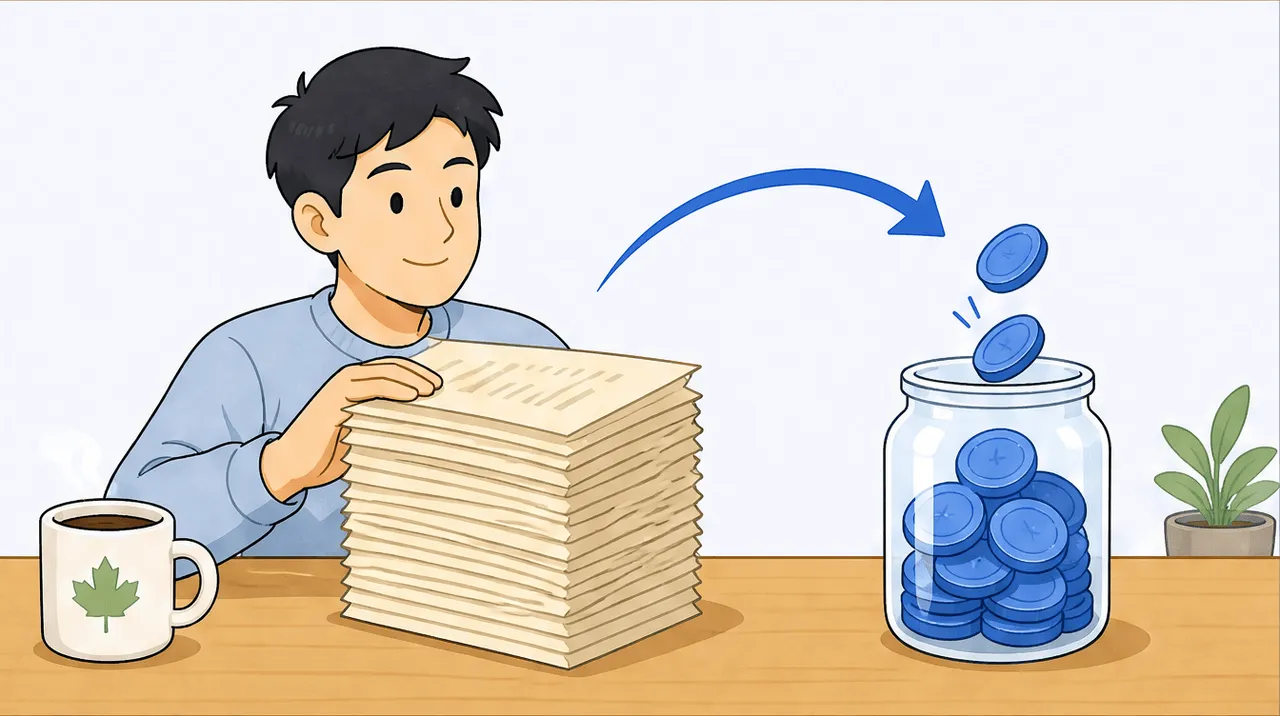
To find every input tax credit in your Q2 receipts, pull all April-to-June business receipts, confirm each one shows the GST/HST amount and the supplier's registration number, map each to its T2125 line, claim only the business-use share, then total the GST/HST to net against what you remit by July 31. Keep the full itemized receipt, not the card slip, because purchases of $100 or more and of $500 or more each need extra detail on the receipt itself.
If you are a GST/HST registrant on a quarterly filing schedule, your April-to-June return and any balance owing are both due July 31. The number that lands on that return is not just the tax you collected. It is that tax minus every input tax credit you can claim on the GST/HST you already paid on business purchases. Miss a credit and you remit more than you owe. The credits do not announce themselves, though. They sit on receipts in your inbox, your glovebox, and a folder you have not opened since April.
This is the deadline-week version of the hunt. If you want the plain-English "what is an input tax credit and who can claim one" primer first, start with the July 31 GST/HST overview. This post is the action: how to pull the receipts, confirm each one qualifies, and total the credits without leaving money on the table. Work through it once and you will know your number with a few days to spare.
General guidance, not tax advice. GST/HST rules depend on your registration and your facts. Confirm with your accountant or CRA before you file.
Step 1: Gather every Q2 business receipt in one place
You cannot claim a credit you cannot find. Start by pulling everything dated April 1 to June 30 that touched the business: card statements, email confirmations, the paper pile, the supplier invoices, the subscription renewals that auto-charged and disappeared. Subscriptions are the ones most people forget, because nothing physical ever arrived.
If your receipts are scattered, this is the slow part. It is also where you decide whether next quarter is easier or the same scramble. Forwarding each receipt to one place as it arrives (scan-ai gives you a code@in.scan-ai.ca address for exactly this) means Q3's pile is already collected on July 31. For now, just get everything from these three months into one stack, digital or physical, before you start sorting.
Step 2: Confirm each receipt actually shows the tax
This is the step that separates a clean claim from a rejected one. CRA does not let you claim an input tax credit on a receipt that lacks the right detail, and the detail required grows with the purchase amount. The card slip from the terminal usually is not enough; you need the full itemized receipt.
Here is what each receipt must show, by size of the purchase:
| Purchase amount | The receipt must show |
|---|---|
| Under $100 | Supplier name (or trading name), the date, and the total amount paid or payable |
| $100 to $499.99 | The above, plus the supplier's GST/HST registration number and either the tax amount charged or a statement that the total includes GST/HST |
| $500 or more | All of the above, plus your name (or trading name), the terms of payment, and a description of the goods or services |
That registration-number rule is why the gas-station card slip fails and the printed receipt passes. As you go through the stack, set aside anything missing its required detail. You may be able to ask the supplier for a proper invoice before July 31. If you cannot get one, you cannot claim that credit, so it is better to know now than to claim it and have it denied.
Step 3: Map each receipt to its T2125 line
Knowing which line an expense belongs on does two jobs at once. It tells you the expense is a real business cost (which is the first condition for an input tax credit), and it lines up your records for the income-tax return that uses the same categories. Most common business purchases map cleanly:
| What you bought | T2125 line | Typical input tax credit |
|---|---|---|
| Online ads, design, marketing | 8521 Advertising | GST/HST on the invoice |
| Office supplies and stationery | 8811 Office stationery and supplies | GST/HST on the itemized receipt |
| Software, subscriptions, memberships | 8760 Business taxes, licences, and memberships | GST/HST on the subscription invoice |
| Accountant, bookkeeper, legal | 8860 Professional fees | GST/HST on the invoice |
| Business premises rent | 8910 Rent | GST/HST on the rent invoice |
| Utilities and business phone | 9220 Utilities | GST/HST on the business-use share |
| Repairs and maintenance | 8960 Repairs and maintenance | GST/HST on labour and materials |
| Fuel and vehicle operating costs | 9281 Motor vehicle expenses | GST/HST on the business-use share |
| Courier, freight, shipping | 9275 Delivery, freight, and express | GST/HST on the invoice |
| Business travel (airfare, lodging) | 9200 Travel expenses | GST/HST on itemized receipts |
If you want the full catalog of T2125 lines and what belongs on each, the CRA business expense categories guide walks through all of them. For the input tax credit total, you only need the receipts that carried GST/HST.
Step 4: Claim only the business-use share
Some costs are partly personal. Your cell phone runs the business app but also your group chat. Your car drives to client sites and to the grocery store. For these mixed-use purchases, you claim the input tax credit only on the business portion, using a split that is fair, reasonable, and applied the same way all year.
For a vehicle that means a kilometre log: business kilometres divided by total kilometres gives the business-use percentage, and you apply that percentage to the GST/HST on fuel and repairs. For a phone, a reasonable business-use percentage applied to the tax on the bill. The principle is the same everywhere: the credit follows the business use, not the full receipt.
Step 5: Total the claimable credits and net them against what you collected
Now add up the GST/HST from every qualifying receipt, after the business-use adjustments. That sum is your input tax credit total. On your return, it comes off the GST/HST you collected from customers. If you collected more than you paid, you remit the difference. If your input tax credits exceed what you collected (common in a quarter with big purchases or slow sales), you may be owed a refund.
A GST/HST input tax credit finder can speed up the matching by showing which expense categories typically carry recoverable tax and what each receipt needs to qualify. Whatever you use to tally it, keep the source receipts. CRA can ask to see the documentation behind the claim, and "I had the receipt in April" is not the same as having it on file.
A note on what counts and what does not
Not every dollar of GST/HST you paid is recoverable. The four conditions CRA applies, in plain terms: you bought the thing for use in your commercial activity, you were registered during the period the tax became payable, the tax was actually paid or payable by you, and you have sufficient documentation and claim within the time limit. A purely personal purchase, a cost from before you registered, or a receipt with no tax shown all fall outside those conditions. The point of the hunt is to find the credits that do qualify, not to inflate the claim with ones that do not.
Frequently asked questions
When is my Q2 GST/HST return due? For monthly and quarterly filers, both the return and the payment are due one month after the end of the reporting period. An April 1 to June 30 quarter is due July 31. If you collect more GST/HST than you can claim in input tax credits, the difference is due by that date too.
Why does the card slip from the terminal not count? Once a purchase is $100 or more, CRA requires the supplier's GST/HST registration number on the receipt, and the card slip rarely shows it. For $500 or more you also need your own name and a description of the goods or services. Keep the full itemized receipt, not just the payment slip.
Can I claim the full GST/HST on something I use partly for personal reasons? No. For mixed-use purchases like a cell phone or a vehicle, you claim the input tax credit only on the business-use share, using a method that is fair, reasonable, and applied consistently through the year. For a vehicle, that means a kilometre log.
What if a receipt is missing the required detail? Try to get a proper invoice from the supplier before you file. If you cannot, you cannot claim that input tax credit, because the documentation condition is not met. It is better to drop one questionable credit than to claim it and have CRA deny it on review.
Do I have to be registered to claim input tax credits? Yes. Only GST/HST registrants can claim input tax credits, and you must have been registered during the reporting period in which the tax was paid or became payable. If you are below the $30,000 small-supplier threshold and not registered, you cannot claim them, though you may choose to register voluntarily.
Your next step before July 31
The credits are sitting in your Q2 receipts right now. Pull the stack, confirm each one shows the tax, map it to a T2125 line, adjust for business use, and total it. That number is what keeps you from over-remitting on July 31.
If gathering the receipts was the painful part this quarter, fix it for next quarter while it is fresh: forward each receipt to your scan-ai email address as it arrives, and Q3's total is half-built by the deadline. You can start free at scan-ai.ca with 20 receipt scans and no credit card, read every line on each receipt, and map it to the right T2125 line as it comes in. When you want to confirm which costs carry recoverable tax, the GST/HST input tax credit finder is there to check against.
General guidance, not tax advice. Confirm your input tax credit claim with your accountant or CRA before you file.