T2125 Guide: Every CRA Business Expense Category, Line by Line
Form T2125, Statement of Business or Professional Activities, is the CRA form where sole proprietors, freelancers and unincorporated professionals report business income and expenses on their personal T1 return. Expenses map to about 20 numbered lines: advertising (8521), meals and entertainment (8523, 50% deductible), office expenses (8810), and capital cost allowance (9936) among them. Put each cost on the line that matches it, claim only the business-use portion, and keep the receipt for six years.
You earned the income. You kept (most of) the receipts. Then tax season arrives, you open Form T2125, and you hit a wall of numbered lines: 8521, 8523, 8810, 8811, 9281, 9945. Which cost goes where? Is your laptop an "office expense" or something called capital cost allowance? Do those client coffees go on the meals line, and why only half of them?
This is a plain-English guide to CRA business expense categories, built to be read line by line. The goal is simple: put every legitimate business cost on the correct T2125 line so you claim what you are entitled to, without the guesswork that invites questions later. We map each expense line number to a real freelancer example, settle the two confusions that trip people up most (office expenses versus supplies, and current expense versus capital asset), and point you to the official Canada.ca page for each rule so you can verify it yourself.
One note up front: this is general information for self-employed Canadians, not personalized tax advice. Your situation has details a webpage cannot know. Where the stakes are high, confirm with a tax professional.
What is Form T2125 and who files it
Form T2125, Statement of Business or Professional Activities, is where you report self-employment income and expenses on your personal Canadian tax return. If you are a sole proprietor, freelancer, gig worker, contractor, consultant, or an unincorporated professional, this is your form. You report your gross income, subtract your eligible expenses, and the difference is the business income the CRA taxes.
The expense side of the form decides how much tax you pay, and it splits into roughly 20 numbered lines. Each line is a category. Putting a cost on the right line is not just tidiness: it is how a deductible expense actually reduces your taxable income, and how you keep your return consistent with the records behind it.
Who does not file a T2125. If you incorporated, the corporation is a separate taxpayer and files its own T2 Corporation Income Tax Return instead. The CRA's corporation income tax return page says every resident corporation has to file a T2 each tax year even when no tax is payable, with narrow exceptions. A T2125 rides along with a personal T1 return, so it is for the unincorporated side of self-employment. Employees with a T4 do not use it either; their employment expenses run through a different form.
When the T2125 is due. Because the T2125 is part of your personal return, it follows the personal deadlines. If you or your spouse or common-law partner were self-employed, the filing deadline is June 15, but any balance owing is still due April 30. The CRA sets both dates out on its due dates for individuals page. A later filing date is not a later payment date, which is the detail that costs people interest. If you are staring down that June date with a shoebox, we wrote a companion piece on turning six months of receipts into per-line totals for the June 15 deadline.
You can see the current form itself on the CRA's T2125 form page, and the line-by-line official commentary in Guide T4002.
The T2125 at a glance
Part 4 of the form lists the numbered expense lines, and business-use-of-home sits further down in Part 5. Here is every one of them, with what belongs there and what does not. Line numbers and labels below are from the current form, T2125 E (25), checked against the CRA's expenses section of Form T2125 on 2 August 2026.
| Line | CRA name on the form | What goes here | What does not |
|---|---|---|---|
| 8521 | Advertising | Ads, business cards, sponsorships, promotional spend | Client meals (8523); limits apply to foreign media aimed at Canadians |
| 8523 | Meals and entertainment | Client meals and entertainment, at 50% | The other 50%; groceries and personal meals |
| 8590 | Bad debts | An amount you already reported as income and cannot collect | A sale or discount you never recorded as income |
| 8690 | Insurance | Commercial and professional insurance on the business | Home insurance (9945) and personal vehicle insurance (9281) |
| 8710 | Interest and bank charges | Business loan interest, business account and card fees | Personal borrowing; mortgage interest on your home (9945) |
| 8760 | Business taxes, licences, and memberships | Business licences, regulatory fees, professional association dues | Dining, recreation and sporting club dues, which are not deductible |
| 8810 | Office expenses | Small consumables that run an office: pens, stamps, paper | Furniture, computers and equipment, which are capital assets (9936) |
| 8811 | Office stationery and supplies | Supplies consumed doing the work itself | Durable tools you keep for years (9936) |
| 8860 | Professional fees (includes legal and accounting fees) | Your accountant, lawyer, bookkeeper | Outsourced management and admin services (8871) |
| 8871 | Management and administration fees | Outsourced management or administrative services | Wages for someone you employ (9060) |
| 8910 | Rent | Rent for an office, studio or co-working space | Rent for your home, which goes through 9945 |
| 8960 | Repairs and maintenance | Fixing business equipment or a rented business space | An upgrade that creates a lasting asset (9936) |
| 9060 | Salaries, wages, and benefits (including employer's contributions) | Pay and benefits for people you employ | Your own drawings as a sole proprietor |
| 9180 | Property taxes | Property tax on business property | Property tax on your home, which goes through 9945 |
| 9200 | Travel expenses | Flights, hotels, trains, ground transport for business travel | Meals while travelling, which still go on 8523 at 50% |
| 9220 | Utilities | Heat, hydro and water at a business location | Utilities for your home office, which go through 9945 |
| 9224 | Fuel costs (except for motor vehicles) | Fuel and oil for business equipment and machinery | Gas for your car, which goes on 9281 |
| 9275 | Delivery, freight, and express | Shipping and courier costs to move goods | Your own travel (9200) |
| 9281 | Motor vehicle expenses (not including CCA) | The business-use share of running your vehicle, from a logbook | The vehicle's depreciation, which is CCA (9936) |
| 9936 | Capital cost allowance (CCA) | The yearly depreciation claim on durable assets, by CCA class | The full purchase price in the year you bought it |
| 9270 | Other expenses (specify) | Legitimate business costs that fit no named line | Anything that has a named line above |
| 9945 | Business-use-of-home expenses | The business share of home heat, hydro, insurance, maintenance, rent or mortgage interest and property tax | An amount that would create or increase a business loss; carry it forward instead |
Three more numbered boxes are arithmetic rather than categories: line 9368 totals your expenses, line 9369 is net income before adjustments, and line 9946 is your net income after the business-use-of-home claim. The form is updated from time to time, so confirm the current numbers on the CRA pages linked above before you file. The rest of this guide walks the lines that carry their own rules.
The one rule behind every category
Before the line numbers, learn the single rule that governs all of them. The CRA lets you deduct reasonable expenses you incurred to earn business income, and you can claim only the business-use portion. Two words carry the weight: "reasonable" and "business-use."
"Reasonable" means the amount fits the activity. A freelance writer expensing a modest laptop is reasonable; the same writer expensing a luxury vehicle "for research" is not. "Business-use portion" means that when something serves both your business and your personal life (your phone, your car, your home), you claim only the share tied to earning income. A phone used 60% for client work gets 60% of its cost claimed, not all of it.
Keep that test in mind and most categorization questions answer themselves. The CRA's own guide, T4002 Chapter 3, lays out this principle and walks through every expense line in detail; it is the authoritative source to check when an expense sits on the edge of two categories.
The complete map of CRA business expense categories by T2125 line
Here is the scannable version. Find your expense, read across to its line number, and use the example to sanity-check the fit. Detailed notes on the trickier lines follow below.
| Line | Category | Plain-English example | Deductible |
|---|---|---|---|
| 8521 | Advertising and promotion | Facebook ads, business cards, a sponsored newsletter spot | Full (business %) |
| 8523 | Meals and entertainment | Client lunch, a coffee meeting with a prospect | 50% only |
| 8590 | Bad debts | An invoice you reported as income but will never collect | Full |
| 8690 | Insurance | Commercial liability or professional insurance on the business | Full (business %) |
| 8710 | Interest and bank charges | Business loan interest, business account fees, card interest on business purchases | Full (business %) |
| 8760 | Business taxes, fees, licences, dues, memberships, subscriptions | Annual business licence, professional association dues, software subscriptions | Full (business %) |
| 8810 | Office expenses | Small items consumed running an office: pens, postage, paper | Full (business %) |
| 8811 | Office stationery and supplies | Stationery and consumable supplies used in the work itself | Full (business %) |
| 8860 | Professional fees | Your accountant, your lawyer, a bookkeeper | Full (business %) |
| 8871 | Management and administration fees | Outsourced admin or management services | Full (business %) |
| 8910 | Rent | Rent for an office, studio, or co-working space (not your home) | Full (business %) |
| 8960 | Repairs and maintenance | Fixing business equipment or a leased workspace | Full (business %) |
| 9060 | Salaries, wages and benefits | Pay for an employee or assistant you employ | Full |
| 9200 | Travel | Flights, hotels, and ground transport for business trips | Full (business %) |
| 9220 | Utilities | Hydro, heat, and water for a separate business location | Full (business %) |
| 9270 | Other expenses | Legitimate business costs that fit no other line | Full (business %) |
| 9281 | Motor vehicle expenses | The business share of running your car | Logbook-based % |
| 9936 | Capital cost allowance | The yearly depreciation claim on bigger assets | By CCA class |
| 9945 | Business-use-of-home expenses | The business share of your home costs | Square-footage % |
Always confirm the current line numbers and labels on the CRA's Expenses section of Form T2125, since the form is updated from time to time.
Line 8521 Advertising and promotion
Anything you spend to get your name in front of customers belongs here: digital ads, print ads, business cards, a booth at a local fair, sponsored content. Advertising in foreign media aimed at the Canadian market has limits, so if you advertise on US platforms targeting Canadians, confirm the details with a professional.
Line 8523 Meals and entertainment (the 50% rule)
Almost everyone gets this one wrong, and it is straightforward once you know it. When you take a client to lunch or buy a prospect coffee to discuss work, you can generally deduct only 50% of the meals and entertainment cost. The CRA's Line 8523 page confirms this 50% limit and lists the narrow exceptions (for example, certain events open to all employees).
The documentation matters as much as the amount. Keep the receipt, and note who you met and the business purpose. "Lunch, $48" is weak; "Lunch with J. Patel re: spring campaign, $48" is the detail that makes the claim defensible.
Line 8590 Bad debts
If you previously included an amount in income (you invoiced it, it counted toward your revenue) and you have since established it is uncollectible, you can deduct it here. This applies to amounts you actually reported as income, not to a discount or a sale you never recorded.
Line 8690 Insurance
Commercial insurance tied to your business goes here: liability coverage, professional indemnity, insurance on business property. Insurance on your home or personal vehicle does not belong on this line; those flow through the home-office and motor-vehicle calculations instead.
Line 8710 Interest and bank charges
Interest on money borrowed to run the business, fees on a business bank account, and interest on a card used for business purchases all sit here. Keep business and personal borrowing separate where you can; that makes the business share obvious.
Line 8760 Business taxes, fees, licences, dues, memberships and subscriptions
Annual business licences, regulatory fees, professional association dues, and work-related subscriptions (including many software tools) belong on this line. Memberships in organizations whose main purpose is dining, recreation, or sport are specifically not deductible, which we cover below.
Line 8810 Office expenses vs Line 8811 Office stationery and supplies
This is the most-confused pair on the entire form, so here is the clean distinction.
Line 8810, office expenses, is for small items you use to run an office and consume in the process: stamps, pens, paper clips, printer paper. Per the CRA's Line 8810 page, this is the home for minor office consumables, and it is not for furniture or equipment. A desk, a chair, or a computer is a capital asset, not an office expense, and is claimed through capital cost allowance.
Line 8811, office stationery and supplies, covers supplies you use directly in the work you do, the consumables the job burns through. The CRA's Line 8811 page frames these as supplies consumed in your business activity.
A quick test: if it is a tool you keep and use for years, it is probably a capital asset (Line 9936). If you consume it running the office, lean to 8810. If you consume it doing the actual work, lean to 8811. Many freelancers reasonably group small consumables together; what matters most is keeping equipment out of both and over in CCA.
Line 8860 Professional fees and Line 8871 Management and administration fees
Fees you pay outside experts, your accountant, lawyer, or bookkeeper, go on Line 8860. Fees for outsourced management or administrative services go on Line 8871. Paying a professional to keep your books straight is itself a deductible expense.
Line 8910 Rent and Line 8960 Repairs and maintenance
Rent for a workspace that is not your home, a studio, an office, a co-working desk, goes on Line 8910. Home rent is handled through the business-use-of-home calculation, not here. Repairs and maintenance to business equipment or a rented business space go on Line 8960.
Line 9060 Salaries, wages and benefits
If you employ someone, their pay and the related benefits go here. As a sole proprietor, you cannot pay yourself a salary on this line; your business income is your income, and drawings are not an expense.
Line 9200 Travel and Line 9220 Utilities
Travel for business, flights, hotels, trains, the cost of getting to and staying at a work destination, goes on Line 9200. Meals while traveling still follow the 50% rule and are reported with meals. Utilities (Line 9220) are for hydro, heat, and water at a dedicated business location. Utilities for a home office flow through the home-office calculation instead.
Line 9270 Other expenses
This is the catch-all for legitimate business costs that fit no other line, for example certain tools, work-specific equipment costs, or private health services plan premiums in some cases. The mistake to avoid is using Line 9270 as a junk drawer. If an expense fits a named line, put it there. "Other" should be the exception, not the dumping ground, and large amounts here are more likely to draw a question.
The three categories that trip freelancers up
Three lines carry their own rules and their own paperwork. Get these right and the rest of the form is bookkeeping.
Motor vehicle expenses (Line 9281) and the logbook the CRA expects
If you use your own car for business, you can deduct the business share of the cost of running it: fuel, insurance, maintenance, registration, and the financing or lease portion. The catch is that you claim only the business-use percentage, and that percentage has to come from somewhere defensible.
That "somewhere" is a logbook. Many self-employed Canadians track business kilometres against total kilometres driven for the year; if you drove 20,000 km and 8,000 were for business, your business use is 40%, and you claim 40% of eligible vehicle costs. The CRA can ask to see the logbook, so a consistent record (date, destination, purpose, distance) turns a reasonable claim into a provable one. scan-ai has a mileage log you can keep alongside the receipts: enter the date, purpose, and kilometres for each business trip and it applies the CRA per-kilometre rate for that year, including the drop after the first 5,000 km and the higher Northwest Territories, Nunavut, and Yukon rates, then carries the total onto line 9281. It will not detect trips for you, so the discipline of recording each drive is still yours; what it removes is the arithmetic and the transcription.
Business-use-of-home expenses (Line 9945) and the calculation
Work from home? You can generally deduct the business share of your home operating costs: a portion of heat, hydro, home insurance, maintenance, and (if you rent) rent, or mortgage interest and property tax if you own.
The business share is usually based on the space you use for work. A common method is square footage: a 150 sq ft office in a 1,500 sq ft home is 10%, so you claim 10% of those home costs. If the space doubles as personal space, you prorate further by the hours it is used for business. The CRA's business-use-of-home page sets out the accepted methods and a key rule: these expenses cannot create or increase a business loss, but any amount you cannot use this year can generally be carried forward to a future year. Because the calculation has real edge cases (selling your home later, the rent-versus-own difference), this is a good area to confirm with a tax professional.
Capital cost allowance (Line 9936): when a purchase is an asset, not an expense
Here is the distinction that quietly costs people the most. A current expense is something you use up in the short term (paper, fuel, this month's software). A capital asset delivers value over years: a computer, a camera, office furniture, a vehicle. You do not expense a capital asset in full the year you buy it. Instead you deduct a percentage of its value each year as depreciation, called capital cost allowance, on Line 9936.
Assets are grouped into CCA classes, each with its own annual rate (computers, for example, sit in a different class than furniture). The mechanics, including the half-year rule that limits the claim in the year of purchase, live in the CRA's CCA guidance. The practical takeaway: when you buy something durable, do not bury it on Line 8810 as an "office expense." Flag it as an asset, keep the purchase receipt, and claim it through CCA. Given the class rules, this is another spot where a quick check with an accountant pays for itself.
What you cannot deduct on the T2125
A short list of common claims that do not survive:
- Personal expenses. Anything not incurred to earn business income, or the personal portion of a mixed-use cost.
- Capital purchases claimed as full expenses. Equipment, furniture, and vehicles go through CCA, not a current expense line, as covered above.
- The full amount of meals and entertainment. Generally only 50% is allowed.
- Club dues for dining, recreation, or sport. Golf memberships and similar recreational club dues are specifically not deductible, even when you sign business there.
- Most everyday clothing. Ordinary clothes are personal, even if you wear them for work. Genuinely specialized protective or uniform gear is a narrower exception worth confirming.
- Your own salary as a sole proprietor. Drawings from the business are not an expense.
When a cost sits in a grey area, the safe move is to confirm it against the T4002 guide or with a professional rather than claim and hope.
Backing up every category: the six-year record rule
Picking the right line is half the job. The other half is proving the number behind it. The CRA generally expects you to keep your business records, including receipts, for six years from the end of the tax year they relate to. If a return is reviewed, the records stand behind each line on your T2125.
Two questions come up constantly here. Do you need the paper original? And does a photo count? The short answer: the CRA generally accepts legible digital copies of receipts, provided they are complete and you can produce them on request. We dug into this in are digital receipts valid for CRA audits, worth reading before you toss a single paper receipt. The principle that matters: a clear, dated, itemized digital record that ties to a line on your return is what audit-readiness looks like.
Let your receipt scanner do the categorizing
Here is the gap between knowing the line numbers and actually using them: doing it by hand, receipt by receipt, all year. That is where scan-ai fits.
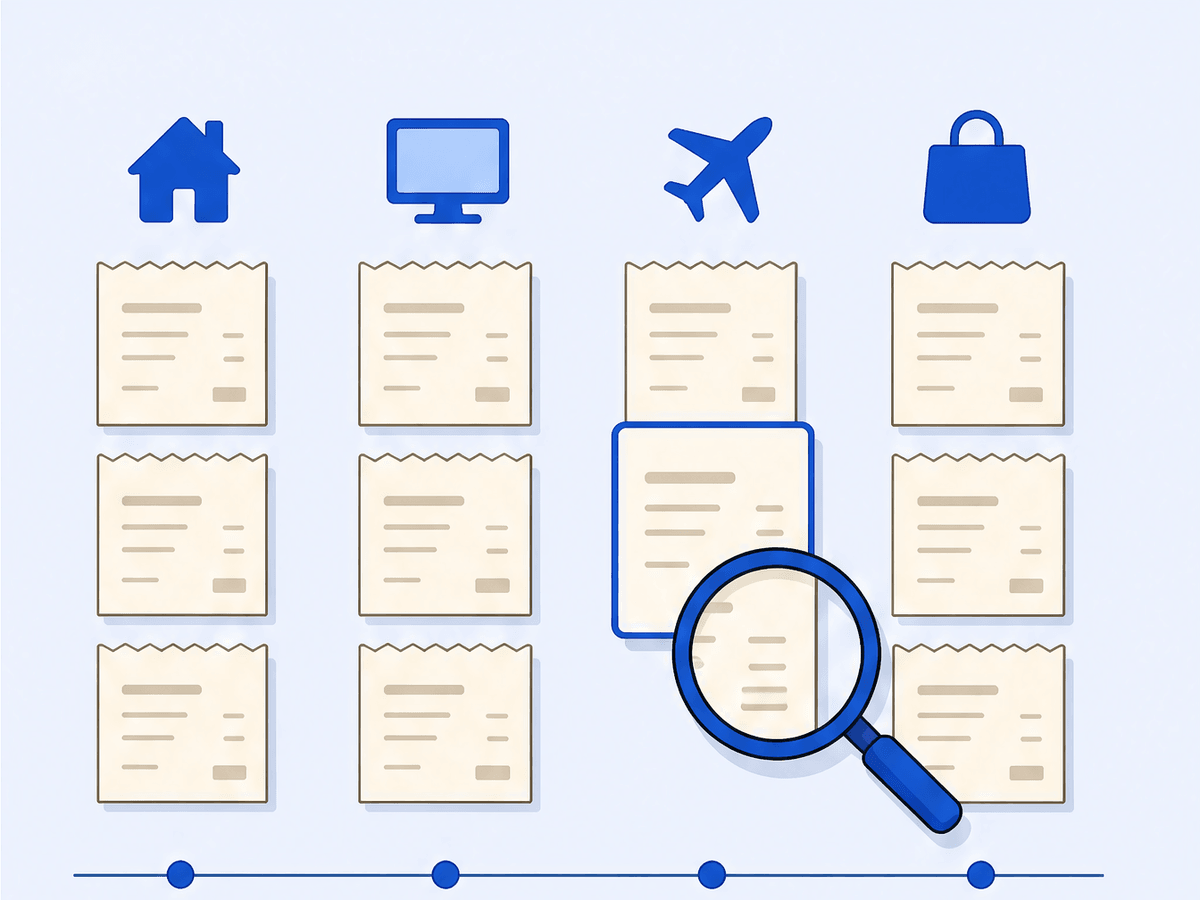
You snap a photo of a receipt, or forward the email confirmation to your scan-ai address, and the AI reads every line on it, including the tax. Then it suggests a tax category mapped to the Canadian T2125 (and US Schedule C, if you work across the border). The coffee with a prospect lands against meals, the printer paper against office expenses, the durable purchase flagged so you treat it as an asset rather than a full expense. You stay in control and confirm each one, but the sorting that used to pile up in a shoebox happens as you go.
Because it all sits in one place, you can also just ask. "How much did I spend on advertising this year?" "Show me every meal receipt." scan-ai answers from your own receipts, so when the T2125 deadline arrives the categories are already done and the records behind them are already clean, categorized, and exportable to CSV. It does not file your return or sync your bank, and it is not a substitute for your accountant; it is the tool that hands your accountant clean, categorized records instead of a bag of paper. For more on the deductions side, see Canadian self-employed tax deductions.
Frequently asked questions
What is form T2125? Form T2125, Statement of Business or Professional Activities, is the CRA form where sole proprietors, freelancers, contractors and unincorporated professionals report self-employment income and expenses as part of their personal T1 return. If you incorporated, you file a T2 corporation return instead.
When is the T2125 due? It follows the personal filing deadlines. If you or your spouse or common-law partner were self-employed, the return is generally due June 15, but any balance owing is still due April 30.
What are the business expense categories on Form T2125? T2125 groups self-employed expenses into about 20 lines, including advertising (8521), meals and entertainment (8523, 50% only), bad debts (8590), insurance (8690), interest and bank charges (8710), business taxes and dues (8760), office expenses (8810), supplies (8811), professional fees (8860), rent (8910), repairs (8960), salaries (9060), travel (9200), utilities (9220), other expenses (9270), motor vehicle (9281), capital cost allowance (9936), and business-use-of-home (9945).
What is the difference between office expenses (Line 8810) and office supplies (Line 8811)? Line 8810 covers minor items used to run an office (stamps, pens, paper) and explicitly excludes furniture and equipment. Line 8811 covers supplies consumed in the work itself. Durable items like a computer or desk belong on neither; they are capital assets claimed through CCA on Line 9936.
Can I deduct meals and entertainment, and how much? Generally yes, but only 50% of eligible business meals and entertainment. Keep the receipt and note who you met and the business reason. A few narrow exceptions exist, which the CRA's Line 8523 page details.
How do I claim home office expenses as a self-employed person in Canada? Calculate the business share of your home (often by square footage, prorated by hours if the space is shared), then claim that share of heat, hydro, insurance, maintenance, and rent or mortgage interest on Line 9945. These expenses cannot create a business loss, but unused amounts can usually be carried forward.
What is capital cost allowance (CCA) and when do I use it? CCA is how you deduct durable assets (computers, furniture, vehicles) a bit each year instead of expensing them at once. Use it on Line 9936 whenever a purchase delivers value over multiple years, rather than on a current expense line.
How do I claim motor vehicle expenses on the T2125? Track business kilometres versus total kilometres to get your business-use percentage, then claim that percentage of fuel, insurance, maintenance, and financing on Line 9281. Keep a logbook; the CRA can ask to see it.
What business expenses can I not deduct on the T2125? Personal-use costs, capital purchases claimed as full current expenses, the disallowed 50% of meals, dining and recreational club dues, most everyday clothing, and a sole proprietor's own drawings.
How long do I have to keep my receipts for the CRA? Generally six years from the end of the tax year the records relate to.
Do I need a paper receipt, or is a digital copy enough for the CRA? The CRA generally accepts legible, complete digital copies you can produce on request. See are digital receipts valid for CRA audits for the detail.
What goes on Line 9270 "Other expenses"? Legitimate business costs that fit no named line. Keep it as the exception, not a catch-all; if an expense has a proper line, use that one.
The answers above are general information for self-employed Canadians, not personalized tax advice. For your specific situation, confirm with a qualified tax professional.
Categorize once, claim with confidence
The T2125 stops being intimidating the moment each receipt has a home. Learn the one rule (reasonable expense, business-use portion), keep the office-versus-supplies and expense-versus-asset distinctions straight, and back every line with a record you can produce for six years.
If you want the year-round version of that habit, the companion guide on how to track T2125 expenses through the year covers the capture-and-categorize routine, and turning six months of receipts into per-line totals for the June 15 deadline covers the catch-up sprint when you have left it late.
You can do that sorting by hand in April, or you can do it as the receipts arrive. Start free at scan-ai.ca: 20 receipt scans, no credit card. Snap or forward a receipt, let the AI read every line and suggest its T2125 category, and walk into tax season with your records already done. We keep it affordable on purpose, which you can read about in why we keep scan-ai cheap.
How scan-ai compares
For one specific job, turning a pile of receipts into tax-ready, categorized records you can ask questions about, scan-ai is the cheapest option here and the one built around the Canadian T2125 and US Schedule C tax lines. It also reads every line on a receipt and gives each line its own tax category, on every plan, where the mass-market tools here (Expensify, QuickBooks, Wave, Shoeboxed) capture only the header total. Dext extracts lines too, but meters that feature and sells to firms. scan-ai starts free with 20 scans and no credit card, and tops out at $10/month for unlimited receipts.
| Tool | Entry price | Free tier | Line-item capture | T2125 / Schedule C tax lines | Ask-your-receipts chat | Built for |
|---|---|---|---|---|---|---|
| scan-ai | Free, then $3/mo (Starter) or $10/mo (Pro), USD | Yes. 20 receipt scans + 5 AI chats, no credit card | Yes. Reads every line on the receipt and gives each its own tax category, on every plan | Yes. Maps each receipt to US Schedule C and Canada T2125 lines | Yes. Ask your own receipts anything in plain language | One freelancer or self-employed person (US + Canada) |
| Expensify | $5 / member / month (Collect plan); Control tier costs more, USD | Mostly paid per member; limited free use | No. SmartScan captures the header: merchant, date, and amount | Not built around Schedule C / T2125 lines (US expense management) | Concierge automates expense tasks; not receipt Q&A | Teams and corporate-card programs |
| Dext (Receipt Bank) | Quote-based; practice plans priced per client, 10-client minimum | Free trial only | Yes, but metered. Line Item Extraction is automatic but spends per-document credits on firm plans | Captures and categorizes, then publishes to accounting software; not a sole-proprietor T2125 map | Not stated | Accounting and bookkeeping firms |
| Shoeboxed | $9 to $179 / month (Starter to Paper Plus), USD | No free plan (30-day money-back guarantee) | No. Captures header fields per receipt: vendor, total, date, and tax | Auto-tags expenses by tax category; T2125 / Schedule C line mapping not stated | Not stated | Receipt digitizing, including mail-in paper scanning |
| QuickBooks Online (Canada) | ~$22 CAD / month regular for EasyStart, the entry plan; intro discounts vary | Free trial only | No. Receipt capture pulls date, vendor, and total; splitting into lines is manual | Full accounting that organizes for tax time, not a per-receipt T2125 line map | Intuit Assist AI rolling out; not focused on receipt Q&A | Full accounting, invoicing, and payroll |
| Wave | Free; Pro $19 USD / $25 CAD per month. Receipt capture is an $11/mo add-on on the free plan | Yes, but receipt capture is a paid add-on or Pro-only | No. OCR fills date, amount, and category; no per-line breakdown | Bookkeeping categories; not built around T2125 / Schedule C lines | Not stated | Free accounting and invoicing |
The bigger suites do things scan-ai does not: bank-feed import, invoicing, and payroll. On mileage, scan-ai logs trips manually and applies the CRA and IRS standard rates, carrying the total onto T2125 line 9281 or the Schedule C vehicle line, but it does not detect trips automatically by GPS the way a dedicated tracker does. scan-ai stays focused on reading receipts, categorizing them to the right tax line, and answering questions about them, priced for one freelancer rather than a team. If you want a full accounting system, pair scan-ai with one or pick a suite. If you mainly need your receipts read, categorized, and searchable, scan-ai does that for less.
Sources, verified June 2026 (prices change; check each vendor)
- scan-ai: scan-ai pricing
- Expensify: Expensify: $5 Collect plan announcement; Expensify pricing; Expensify SmartScan: pulls merchant, date, amount
- Dext (Receipt Bank): Dext pricing (business); Dext plans for accountants and bookkeepers; Dext Line Item Extraction (credit-metered)
- Shoeboxed: Shoeboxed pricing; Shoeboxed: data captured per receipt
- QuickBooks Online (Canada): QuickBooks Online Canada plans and pricing; QuickBooks Online EasyStart (Canada); QuickBooks: receipt capture pulls date, vendor, total
- Wave: Wave pricing; Wave: scan and upload receipts (date, amount, category)